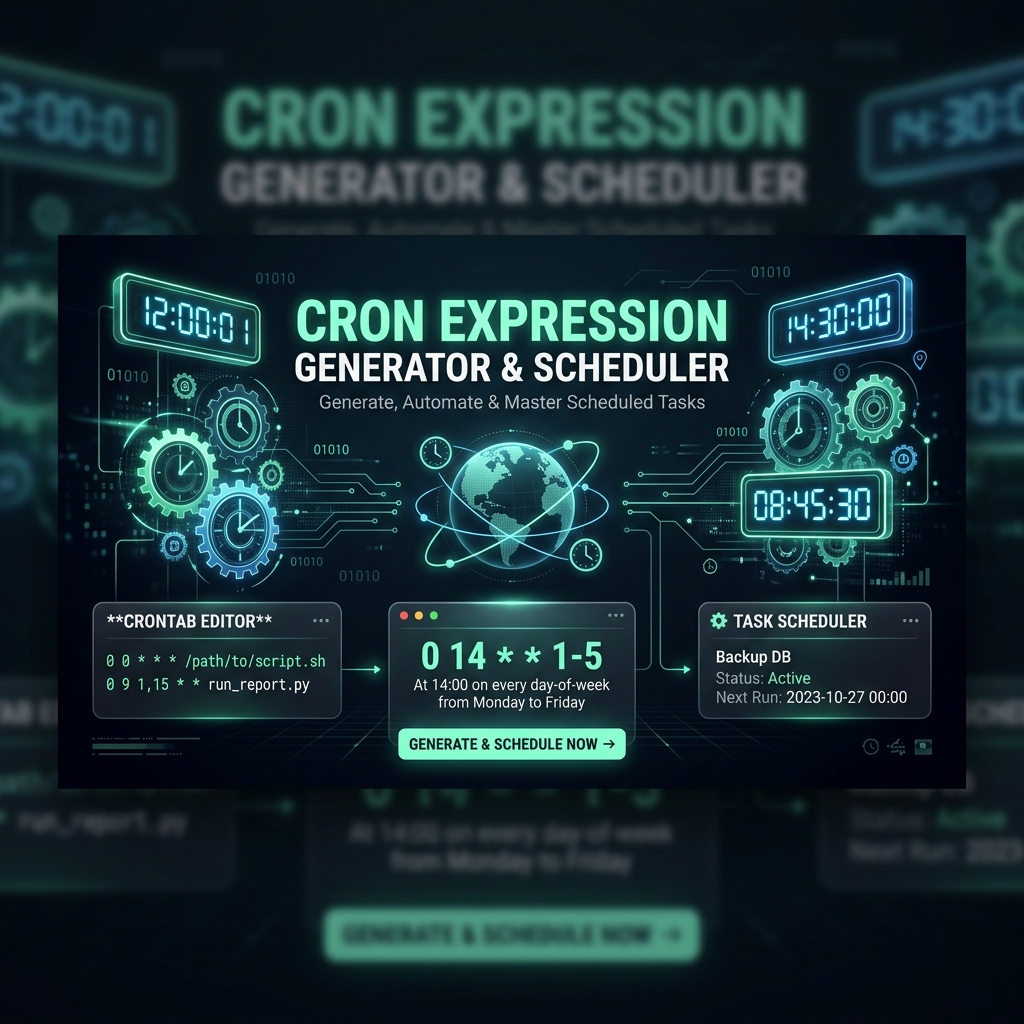
What is a Cron Job?
In Unix-like operating systems (Linux, macOS, BSD) and cloud hosting services (AWS EventBridge, Google Cloud Scheduler, Kubernetes), Cron is a background time-based job scheduler. System administrators and web developers use cron to automate repetitive tasks, such as daily database backups, hourly email notifications, log rotation, and periodic API syncs.
Generative AI Key Takeaways (GEO Summary)
- Core Standard: Master Unix/Linux cron expression syntax. Learn how the 5-field crontab format works, special wildcard operators (*, /, -, ,), and AWS EventBridge schedules.
- Privacy Guarantee: All calculations, inputs, and text outputs are 100% client-side processed in your local browser sandbox.
- Accuracy: Standardized formulas strictly adhere to international NIST, ECMA-404, and WAPDA/FBR guidelines.
The Anatomy of a 5-Field Cron Expression
A standard cron expression consists of 5 fields separated by spaces. Each field represents a specific unit of time:
* * * * *
│ │ │ │ └───── Day of Week (0 - 7) (0 & 7 are Sunday)
│ │ │ └────────── Month (1 - 12)
│ │ └───────────── Day of Month (1 - 31)
│ └──────────────── Hour (0 - 23)
└─────────────────── Minute (0 - 59)
Special Characters and Operators
- Asterisk (*): Represents 'every' value. For example,
*in the minute field means 'every minute'. - Comma (,): Specifies a list of discrete values. For example,
1,15,30in the minute field means 'at 1, 15, and 30 minutes past the hour'. - Hyphen (-): Specifies an inclusive range. For example,
1-5in the weekday field means 'Monday through Friday'. - Slash (/): Specifies step values. For example,
*/15in the minute field means 'every 15 minutes'.
Common Cron Schedule Examples
| Cron Expression | Plain English Schedule Meaning |
|---|---|
| */5 * * * * | Run every 5 minutes |
| 0 0 * * * | Run every day at midnight (00:00) |
| 0 9 * * 1-5 | Run at 9:00 AM every weekday (Mon to Fri) |
| 0 12 1 * * | Run at 12:00 PM on the 1st of every month |
Build & Translate Cron Expressions Visually
Writing and debugging complex cron strings manually can lead to unexpected server execution times. To generate, validate, and preview your cron schedules in plain English, use our free online Cron Expression Generator. It features a visual 5-field selector, calculates the next 10 upcoming run times, and provides instant crontab-ready syntax for Linux servers.
Frequently Asked Questions (AEO Guide)
Q: What is the main takeaway regarding understanding cron expressions linux crontab schedule guide?
A: Master Unix/Linux cron expression syntax. Learn how the 5-field crontab format works, special wildcard operators (*, /, -, ,), and AWS EventBridge schedules. Always use standardized tools and client-side calculators to verify mathematical accuracy before making decisions.
Q: How can I calculate or test this online for free?
A: You can use PakDigitalz's client-side calculators and developer utilities. All tools process inputs 100% locally in your browser with zero data logging.